
Residue trapped in the infill
As urine passes through, some residue clings to the infill granules and breaks down over time.
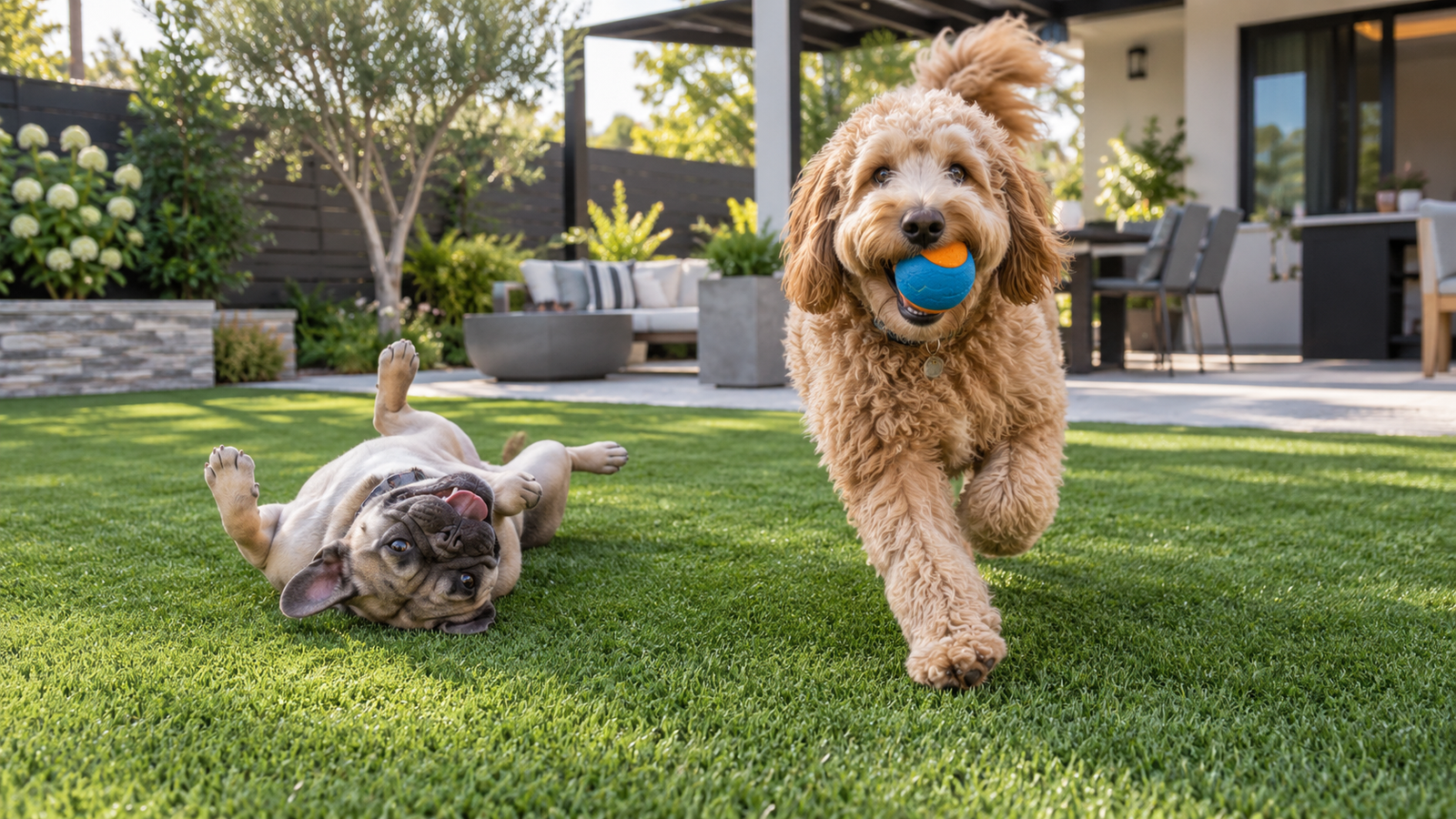
Pet Turf & Odor
A focused answer on the path urine takes through a turf system, where residue gets trapped, and why the surface can look fine while odor builds underneath.
When a dog urinates on artificial turf, the liquid does not stay on top. It passes through the blades, into the infill, through the backing, and into the base or drainage layer beneath. Some residue clings to the fibers and infill along the way, and the rest moves downward. A well-built system is designed to move that liquid out through the drainage path.
If the drainage path below is clear, most liquid exits the system. If the base is compacted, the slope is poor, or a drain is blocked, urine and water sit under the turf and feed odor continuously. This is why odor is often a drainage problem as much as a cleaning problem — the surface may look fine while contamination builds underneath.
Understanding the path helps explain why surface treatments alone often disappoint: they address the top of the system while the real residue has moved through it. A complete odor plan treats the infill and backing and makes sure drainage actually moves liquid out from under the turf.
On this page
Understanding the driver helps choose cleaning, repair, maintenance — or a larger scope conversation.
As urine passes through, some residue clings to the infill granules and breaks down over time.
Urine that reaches the backing can collect there, especially where drainage holes are slowed by compaction.
When the base, slope, or drain cannot move liquid out, urine and water pool beneath the surface and feed odor.
A favorite bathroom spot overloads a small area of the system faster than the rest of the turf.
Photos help triage. Some conditions only show after walking the surface, checking drainage, and lifting a corner when appropriate.
01
An assessment checks slope, drains, and whether liquid ponds under or at the edge of the turf.
02
Infill depth, compaction, and contamination show how much residue the system is holding.
03
The estimate matches the cleaning and enzyme treatment to where the contamination actually lives.
Straight talk about what a repair, cleaning, or documentation can and cannot deliver.
A surface rinse does not reach residue that has moved through to the infill, backing, or drainage layer.
No company should guarantee zero odor; the goal is real reduction through treatment and drainage, not a permanent fix.
Whether drainage correction is needed is confirmed after an on-site diagnostic, not from photos alone.
Send wide and close-up photos, or book a visit. Cleaning, odor treatment, and repairs are evaluated separately and approved before work begins.