
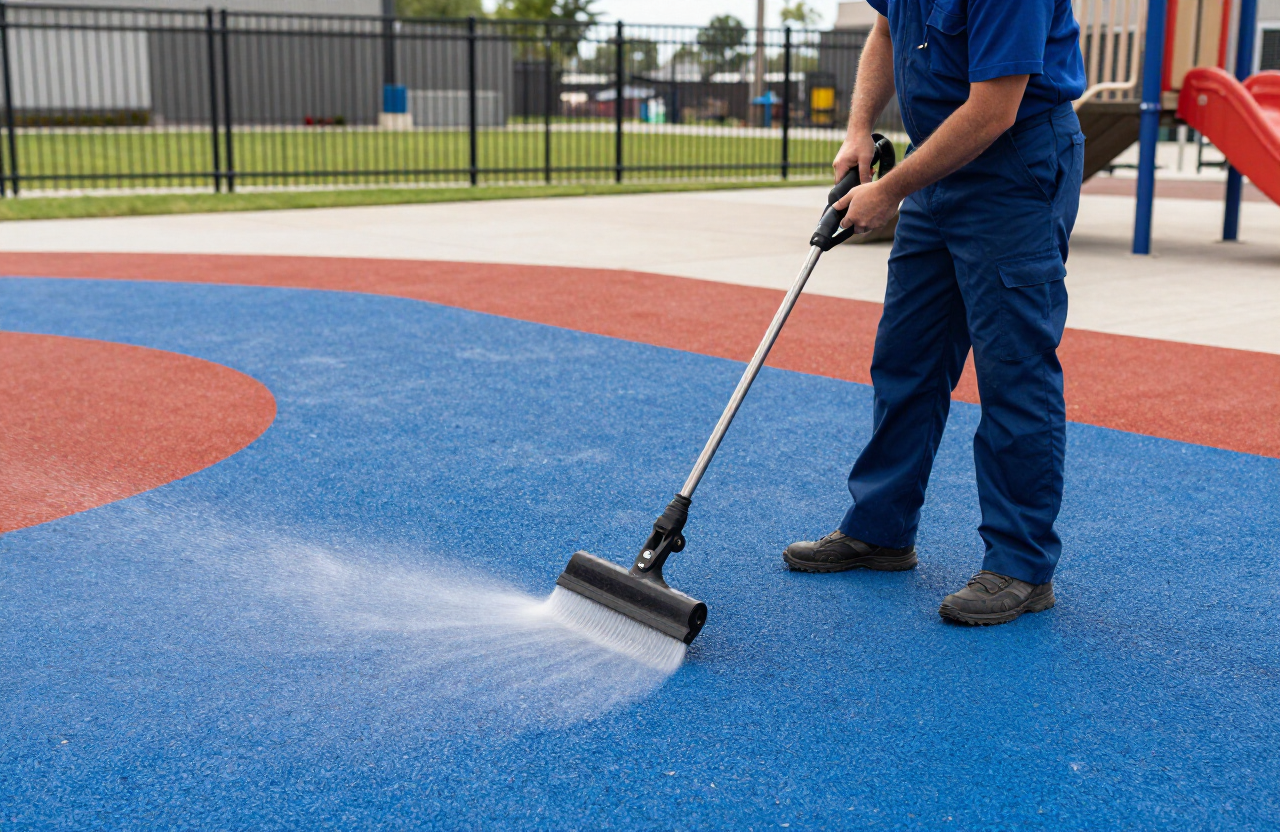
Program 04 · PIP Rubber
PIP Rubber Repair & Restoration
A full repair ladder — not just clean or replace. We diagnose which layer has failed and respond at the right stage.
PIP Rubber Repair & Restoration
Poured-in-place (PIP) rubber is not a clean-or-replace product. It has a lifecycle, and the right response depends on which layer has failed. SynTurf Care diagnoses the stage and responds at the right level — from surface cleaning all the way to sectional or full replacement.
ASTM F2479’s PIP guidance specifically addresses maintenance and aging issues including loss of impact absorption, cracking, shrinkage and heaving. UV deterioration of the polyurethane binder leads to granulation, cracking and holes.
The wrong pressure, solvent or chemical can accelerate deterioration. Methods, chemistry, pressure, temperature and dwell time are selected by surface type and available manufacturer guidance.
- Stage 1 — Dirty / stained / organic buildup: surface-specific cleaning
- Stage 2 — Early granulation / binder deterioration: manufacturer-compatible binder restoration / top treatment where appropriate
- Stage 3 — Small cracks / holes: spot patch
- Stage 4 — Worn colored wear layer: wear-layer repair
- Stage 5 — Widespread top-layer deterioration: re-top / cap / resurfacing
- Stage 6 — Local cushion-layer damage: full-depth localized repair
- Stage 7 — Base / drainage failure: base correction + surface reconstruction
- Stage 8 — Broad structural / end-of-life failure: sectional or full replacement
- “What is happening to my rubber?” diagnostic support
- Preventative binder and wear-layer restoration evaluation
How SynTurf Care Approaches This
A documented, surface-aware process — not a one-size-fits-all cleaning routine.
01
Layer diagnosis
Determine which layer has failed — wear layer, cushion layer, binder, edge or base — and at what lifecycle stage.
02
Compatibility check
Evaluate surface type (EPDM, TPV, SBR, tile, PIP), age and available manufacturer guidance before selecting methods or products.
03
Right-stage response
Match the response to the stage — clean, restore, patch, re-top, reconstruct or replace — instead of jumping straight to replacement.
04
Document and monitor
Photograph before / after, record materials used, and schedule the next inspection in the Surface Passport.
What This Program Is Designed to Deliver
Every playground program is built around credible, defensible outcomes — maintenance and documentation first, with qualified inspection and impact-testing coordination kept as separate scopes.
- Multiple levels of rubber repair — not just “clean or replace.”
- The wrong pressure, solvent or chemical can accelerate deterioration.
- Cleaning methods, chemistry, pressure, temperature and dwell time are selected by surface type and manufacturer guidance.
- Preventative binder restoration may extend the serviceable wear layer before severe granulation occurs.
- A re-top / cap coat is only appropriate when the cushion and base layers beneath are still viable — we evaluate that first.
- Repair and restoration do not certify or restore impact performance — qualified testing is a separate scope.
- Some end-of-life or base-failure conditions require replacement rather than restoration.
- Manufacturer compatibility must be confirmed before any binder or top treatment is applied.
- When PIP rubber is shedding granules, cracking or developing holes
- When the colored wear layer is worn but the cushion layer is intact
- When binder deterioration is early enough for restoration rather than replacement
- When a base or drainage failure has damaged a localized section
PIP Rubber Repair & Restoration — Questions
Credible answers about this playground surface program, the maintenance/documentation scope, and what stays a separate qualified scope.
Sometimes. A re-top / cap coat can install a new EPDM wearing course over a viable existing attenuation layer. Whether that is appropriate depends on the condition of the cushion and base layers beneath, which we evaluate first.
Related Playground Surface Programs
The complete six-product playground lifecycle — assessment, recurring care, repair, PIP rubber restoration, performance coordination and documentation.
Ready to Put PIP Rubber Repair & Restoration to Work?
Request a site assessment for your daycare, school, HOA or public facility. We will establish the surface system, condition and records baseline.